Keep Forging the Mind
Why I keep learning across art direction, 3D, motion and AI — and what research can teach us about staying curious, capable and willing to begin again.
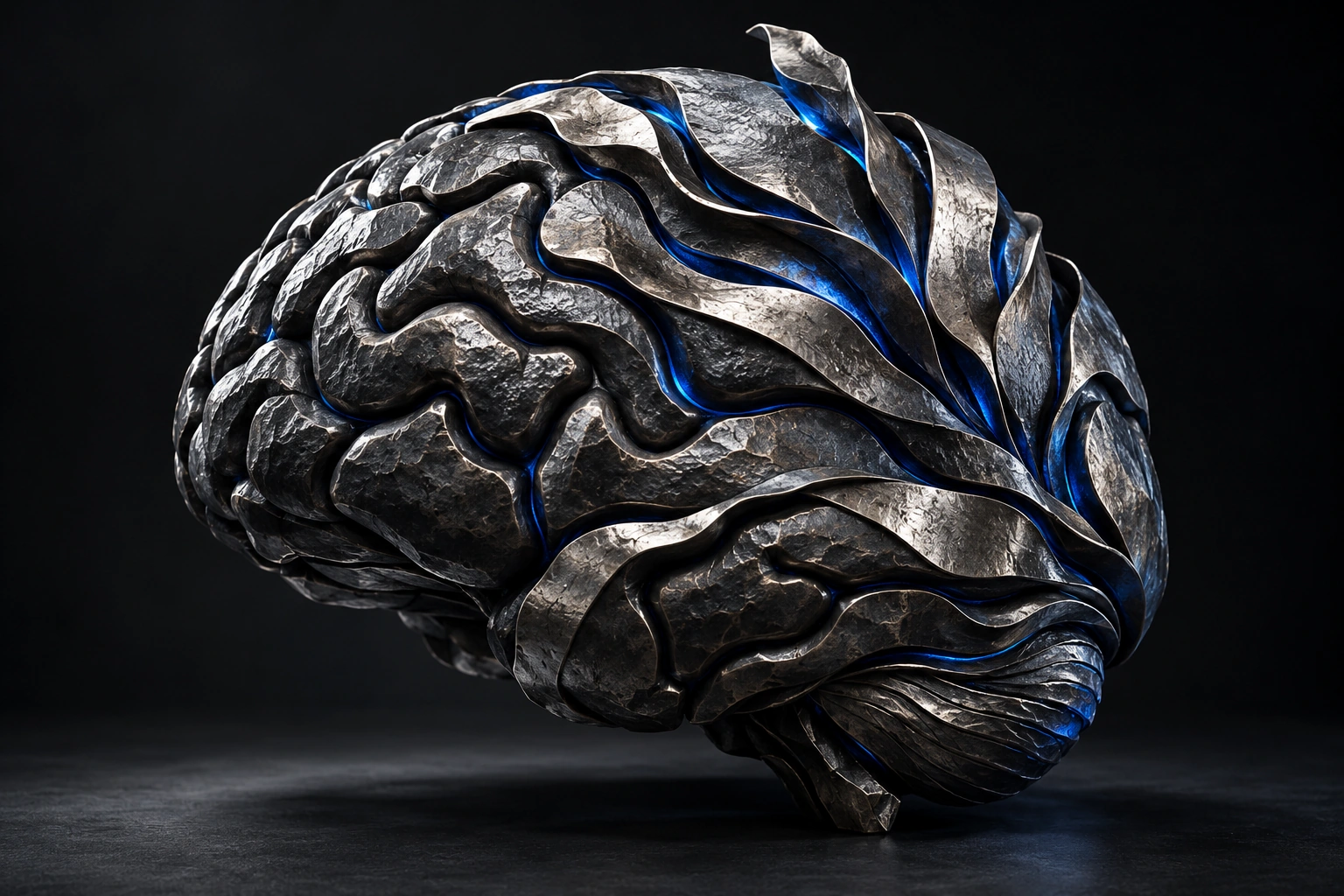
An Arabic reflection I came across made me pause. Its central idea was simple: we notice an empty stomach much sooner than a mind that has stopped receiving anything new. I read it as a question about attention. What am I feeding my curiosity? And when did I last give myself something difficult to understand?
That question belongs in a creative practice. A full calendar can hide a comfortable routine. You can keep delivering, keep using the same methods, and slowly lose the habit of asking whether there is a better way.
I keep forging my skills because I want my ideas to have room to grow. Moving between art direction, 3D, motion and AI gives me different ways to think and make. Each unfamiliar process asks me to become a beginner again. Experience helps me choose a direction; curiosity keeps that direction open.
The mind can change. The metaphor has limits.
In a 2008 study, Driemeyer and colleagues followed 20 healthy adults learning to juggle. MRI measurements showed changes in grey matter in areas involved in processing visual motion during the learning period. Some changes receded after practice stopped. It is a small, specific study of a motor skill, not a measurement of creativity or wisdom. [1] Driemeyer et al. (2008) — learning and structural brain changes
The useful lesson is that adult brains can respond to learning. The study does not establish that missing a week of reading damages your brain, or that professional stagnation is a neurological diagnosis. When I talk about feeding the mind, I mean giving attention, questions and practice a place in my life. The metaphor should encourage us, not pretend to be medical evidence.
Watching is the beginning. Can you do it afterwards?
A tutorial can feel productive because everything makes sense while someone else is doing the work. The harder test comes after closing it. Can you reconstruct the process? Can you explain why a choice worked? Can you use the principle on a different brief?
Dunlosky and colleagues reviewed ten learning techniques in 2013. Practice testing and distributed practice received their highest utility ratings; rereading and highlighting received lower ratings. Their review concerns learning and educational tasks. Applying it to studio work is a practical interpretation, rather than a direct experiment on art directors. [2] Dunlosky et al. (2013) — a review of ten learning techniques
My suggestion is to turn a reference into a test. Study a lighting setup, close the reference, and build a version from memory. Then compare the results and correct the gaps. For motion, explain the timing before reopening the timeline. For an AI workflow, describe what each stage contributes before running it again.
Return to the skill before moving on
Cepeda and colleagues’ 2006 review brought together 317 experiments on distributed practice in verbal recall. It supports the value of spacing learning over time, while showing that useful spacing depends on how long the material needs to be retained. There is no single perfect interval for every task. [3] Cepeda et al. (2006) — a meta-analysis of distributed practice
For a creative skill, I would start with a modest experiment: learn one technique, attempt it again a few days later, then apply it in a small project the following week. Treat that schedule as a starting point to adjust. A saved tutorial is a resource; a technique you can retrieve and adapt is becoming part of your craft.
Repetition needs a question
More hours do not automatically produce better judgement. Macnamara, Hambrick and Oswald’s 2014 meta-analysis found that deliberate practice explained part of the differences in performance, with its contribution varying considerably across fields. Practice matters, but it is not a complete explanation of expertise or a guarantee of success. [4] Macnamara, Hambrick & Oswald (2014) — deliberate practice and performance
I would rather give a session one clear target: make the material read more convincingly, improve the transition between two shots, or make a product remain consistent across a sequence. Compare versions. Ask someone what feels unresolved. Change one variable so you can understand what helped. Repeating a weak decision more quickly can make you efficient at the wrong thing.
I want every new tool to sharpen my judgement, and every new skill to give an idea more room.
What standing still can cost
In its Future of Jobs Report 2025, the World Economic Forum reports that surveyed employers expect 39% of workers’ core skills to change by 2030. That is an employer forecast, not a claim that 39% of people will lose their jobs. The same report identifies creative thinking, curiosity and lifelong learning among skills expected to grow in importance. [5] World Economic Forum (2025) — employer expectations for changing skills
For a creative professional, I see the risk in smaller decisions first. A brief arrives that your familiar process cannot handle. You repeat an old visual answer because you cannot execute a new one. You accept a tool’s output because you lack the knowledge to challenge it. Eventually, a narrower set of capabilities can mean a narrower set of opportunities. These are professional risks I take seriously, rather than outcomes the research predicts for every individual.
Learning cannot remove every barrier. Time, money, access, health and the market all affect what someone can do. Employers also have a responsibility to make development possible. Still, protecting some space to learn gives us more options when the work changes.
AI makes judgement worth practising
A study by Dell’Acqua and colleagues, first circulated in 2023 and published in Organization Science in 2026, tested 758 knowledge workers using GPT-4 on consulting tasks. AI assistance improved performance on tasks within its capabilities, while reducing correctness on a task selected to fall outside them. The results describe that model and experimental setting; they are not a verdict on every AI system or creative task. [6] Dell’Acqua et al. (2026; first circulated in 2023) — the jagged technological frontier
For me, the implication is practical: learn the tool and the craft that lets you evaluate it. An attractive frame still needs believable light. A moving character still needs continuity. A campaign still needs an idea, a point of view and choices that hold together. I want to understand enough to know when to generate, when to rebuild, and when to choose another method.
A learning routine you can actually keep
Here is a simple weekly structure to adapt to your time. It is a suggested routine, not a scientifically validated formula:
- Choose one specific weakness. “Improve lighting on reflective surfaces” gives you a clearer target than “get better at 3D.”
- Study one good explanation or reference. Write down the principle you want to test, rather than collecting ten more tutorials.
- Make a small attempt without following along. Keep the scope short enough to finish and inspect.
- Compare, seek specific feedback, and correct one problem. Keep a note of the decision that improved the result.
- Return after a few days. Rebuild the technique and try it under a different constraint.
- Finish a small piece and review what transferred. Protect rest and leave room for interests beyond work; the routine needs to fit a life.
Keep the beginner in the room
After years of making images, it is tempting to protect the feeling of being competent. Learning interrupts that comfort. You make something clumsy. You discover a gap in your understanding. You need help with a process that someone else finds obvious.
I want to keep room for that experience. It lets me bring a stronger eye to the next image, a better question to the next brief, and another possible solution to the next problem. Keeping my skills in motion is part of taking the work seriously.
Start with one question you have been avoiding. Give it a small, finished experiment. Come back and see what you can now do. That is how I want to keep forging the mind behind the work.